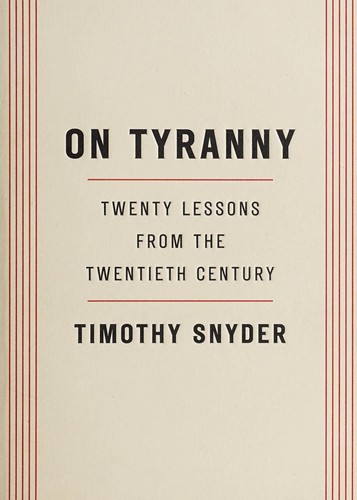

On tyranny

twenty lessons from the twentieth century

126 pages

English language

Published Jan. 24, 2017 by Crown, Tim Duggan Books.

ISBN:
978-0-8041-9011-4
Copied ISBN!
OCLC Number:
968309193

View on OpenLibrary

In previous books, Holocaust historian Timothy Snyder dissected the events and values that enabled the rise of Hitler and Stalin and the execution of their catastrophic policies. With Twenty Lessons, Snyder draws from the darkest hours of the twentieth century to provide hope for the twenty-first. As he writes, "Americans are no wiser than the Europeans who saw democracy yield to fascism, Nazism and communism. Our one advantage is that we might learn from their experience."

2 editions

Read State and Revolution instead

This is a work of exceptionally poor liberal political theory, doomed to be so because of the author's lack of historical education and historical materialist perspective as well as his commitment to a short "pop" style structure. The author makes fundamental errors on defining communism and fascism by avoiding the question of political economy, and as a result his explanation on what "tyranny" is and how to fight it is hollow. His anti-communist views lead to glaring historical omissions that result in outright misinformation. For instance, he complains about Austrians complying in advance with the Nazis in 1938, but this completely ignores the defeat of anti-fascist forces in the 1934 Austrian Civil War. In general, his suggestions to fight "tyranny" are platitudes with little substance. There are surely better works on the subject out there by actual anti-fascists.

reviewed On tyranny by Timothy Snyder

Useful book with some flaws.

Does not properly distinguish power from authority, i.e. "A citizen who adapts in this way is teaching power what it can do. Anticipatory obedience is a political tragedy."

Historical details were glossed over in the prologue which might misinform some readers.

The Yale experiment on fascism is presented to imply that by human nature we are naturally quick to harm one another, in some twister Hobbesian assumption - rather than a product of the limited sample size in a small study under specific economic, political, and societal conditions of the USA.

Otherwise, there are many great ways to defend against and confront Tyranny that are applicable primary to the USA, and secondarily to other western democracies.

Important and Timely

I was in the middle of reading The Armageddon Protocol, the latest science fiction thriller from Dan Moren. He’s my favorite newish author, with six novels out now, each better than the last (and the first one was excellent). More people should know about his books.

Anyway, I set that aside to begin reading a 2017 book by Yale historian Timothy Snyder. It offers ““twenty lessons from the twentieth century, adapted to the circumstances of today” and is the source of many quotes and memes going around the last few days. It’s a quick easy read. If you voted for the guy and think the current panic is hyperbole, I recommend reading this book if only to reassure yourself that it is hyperbole and to see what to watch for to ensure you’re on the right side of history if the bottom ever were to fall out. And for …

A brief, rational reflection on tyranny

This was an easy to read and digest collection of lessons on tyranny. This isn't an anatomical analysis of what tyranny is nor is it a definitive prescription of cures. It's collection of broad insights that come from historical accounts. The author speaks equally about events under Nazi and Communist governments that provide insights into how tyrannical governments operate.

The writing felt very centrist and balanced. He clearly tried to avoid leaning left or right and simply presented a series of lessons based on factual events.

A brief, rational reflection on tyranny

This was an easy to read and digest collection of lessons on tyranny. This isn't an anatomical analysis of what tyranny is nor is it a definitive prescription of cures. It's collection of broad insights that come from historical accounts. The author speaks equally about events under Nazi and Communist governments that provide insights into how tyrannical governments operate.

The writing felt very centrist and balanced. He clearly tried to avoid leaning left or right and simply presented a series of lessons based on factual events.

Subjects

  • Political culture
  • Modern History
  • SOCIAL SCIENCE
  • Democracy
  • 20th Century
  • Modern
  • Twentieth century
  • Political ethics
  • Despotism
  • POLITICAL SCIENCE
  • Essays
  • Civics & Citizenship
  • HISTORY

Places

  • United States