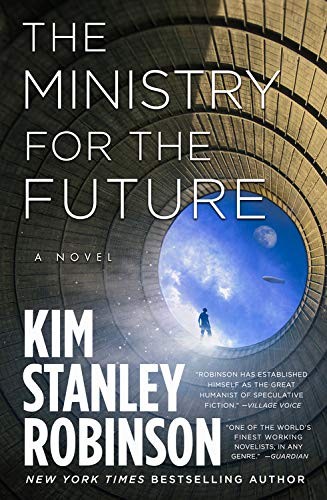
I read this over a few months with an in-person book club, and it was a great choice for that because it has a lot to discuss. It opens with an incredibly harrowing description of the sort of heat wave disaster that the world hasn't seen yet but I think is plausible not far in the future. And from there it basically follows three interwoven threads:
* The UN establishes a climate change super-org that gets dubbed the "Ministry for the Future" because its official name is far too unwieldy government-speak
* India decides after the heatwave that it can't afford to wait for the world to get its shit together, and starts going it alone on geoengineering, to global consternation but also spurring some more serious action from other parties
* The character from whose point of view we saw the disaster is very deeply scarred by the experience and devotes the rest of his life to climate action by any means necessary
In true KSR style, the book is very long on research and loving descriptions of places (mostly Switzerland this time; he's made me want to visit Zurich), and relatively short on three-dimensional characters. I think this one does a better job with the characters than Red Mars, because he picked a couple (Frank and Mary) to focus on and managed to bring those to life somewhat, while letting others just be functions in the story. But it's definitely still his weak point as a writer.
The book goes through a grim ride, in which there's a lot more loss, and it takes a huge amount of work and delay to get to meaningful global action. All of which seems sadly realistic to me. I think KSR's also right that in the end the levers will be social and financial system changes, not some amazing new technology. But his proposal for those changes feels weirdly credulous about Bitcoin, and thin on details about how it would actually achieve its social objectives - which would be fine for a straight work of fiction, but is jarring compared to how much deep research there clearly is in the climate system and technology parts of the story.
It eventually leads to a sort of optimistic conclusion, a somewhat believable scenario of humanity living within its means at last, and some aspects of that vision being genuinely appealing. But that end state has two glaring omissions which ultimately detracted a lot from the book for me.
One is that there's been a triumph of this "half Earth" movement about physically limiting human habitation to half of the land surface, to rewild the rest. But... everywhere habitable is someone's ancestral land. What happened to those people? Were they consulted, compensated, persuaded, or moved along yet again? And most of those ecosystems' stable pre-industrial states were ones of dynamic equilibrium actively maintained by humans - simply withdrawing wouldn't do what this book seems to assume it will.
The other is that there's this lovely vision of long haul travel being done by boat and airship, which in turn is practical because people get to work on their laptops. Which would be great for me! But what's a plumber supposed to do? I can only be so happy about a future in which migrants' ability to see our families is contingent on us having remote work compatible jobs. And the way that's not discussed left me feeling like KSR had only really thought about this future for himself.